
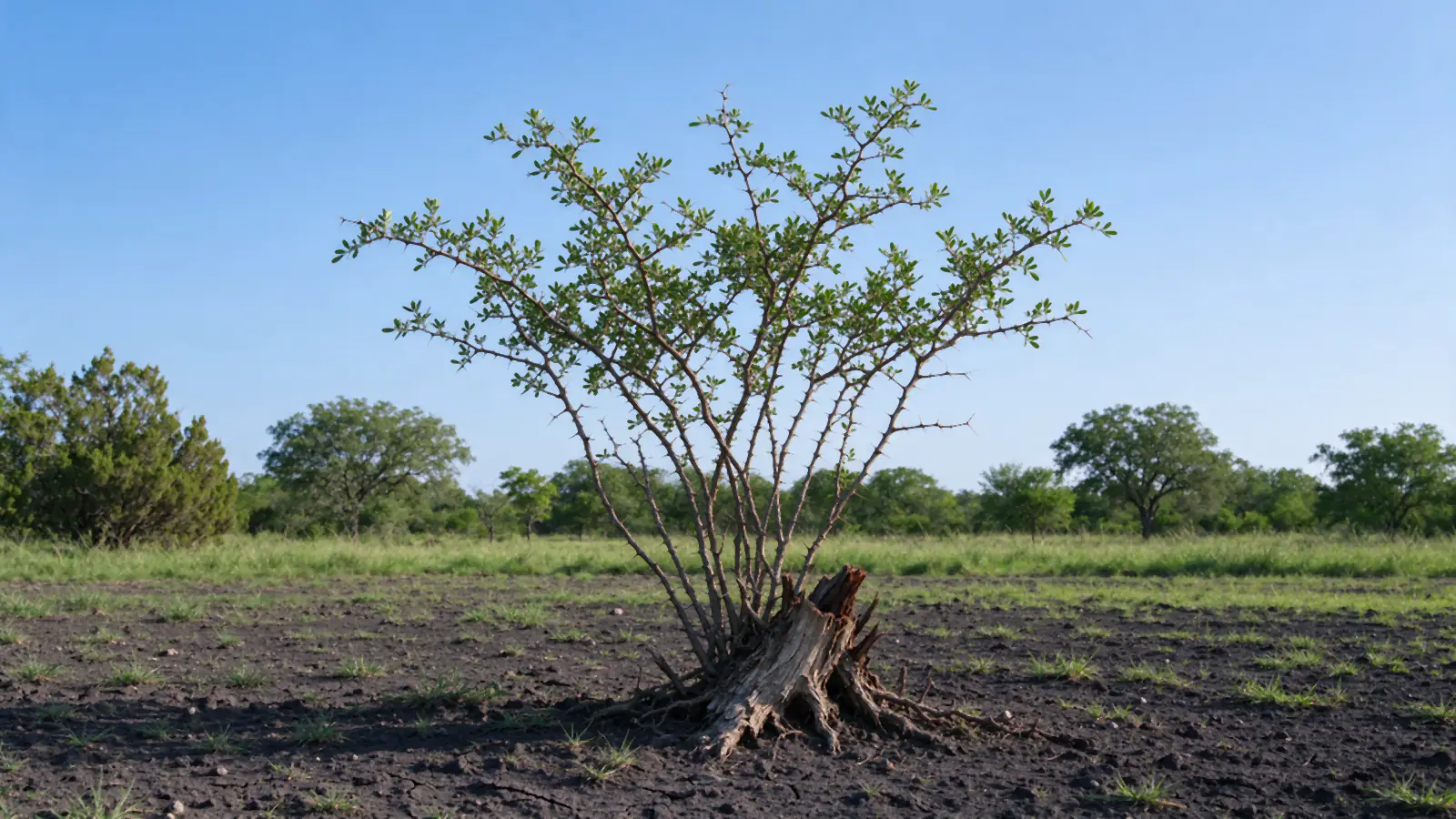
Short answer: honey mesquite keeps a ring of dormant buds at and just below the soil line. Shredding, mowing or cutting above that bud zone removes the top but leaves the buds alive, and each cut wakes several of them, so one trunk comes back as a clump of stems. Removing mesquite for good means grubbing at least about 14 inches deep, below the bud zone, or treating it with a labeled herbicide.
Arcady Temple Land Clearing clears mesquite across the Blackland pastures of Bell County, where this question comes up on almost every job.
The bud zone
Many trees die when their trunk is cut. Mesquite does not, because it stores growing buds at and just below the ground, around the base of the stem and on the upper roots. Range scientists describe honey mesquite as a prolific resprouter for this reason. When the top is removed, those buds start growing, fed by the root system that is still intact.
Compare Ashe juniper, the cedar common in Bell County, which has no buds on its trunk and dies when cut below its lowest green limb. The guide on whether brush grows back compares the species.
Why shredding makes it worse
A shredder or mulcher cuts mesquite at or just above the ground, above most of the bud zone. Each cut wakes several buds, so a single-trunk tree comes back as a clump of five or six stems. Shred it again, and each of those stems does the same. That is why a pasture shredded every few years often has more mesquite, not less: shorter, thornier and harder to walk through.
Reading a mesquite stand
A pasture’s mesquite tells its own history. Big trees with a single trunk have usually never been cut. Low clumps of five, ten or more stems coming from one spot have been shredded or cut, often more than once. New single seedlings scattered through the grass come from seed, often spread by cattle and wildlife eating the pods. Each needs a different answer, which is why the walk-through counts clumps as well as trees.
Getting below the buds
Mechanical removal has to reach below the bud zone. Brush management guidance for mesquite and hardwoods calls for grubbing at least about 14 inches deep to remove basal and root buds.
- Individual trees are grubbed with an excavator or a dozer with a grubbing tool.
- Whole fields can be root plowed, which drags a blade below the surface and cuts roots beneath the buds, leaving bare ground to seed.
- Grinding a stump only works if the grinder goes below the bud zone. See stump grinding versus removal.
Digging that deep is close to the 16-inch depth where Texas law requires a Texas811 locate request, so grubbing starts with one.
Shredding the same mesquite every few years?
Send photos and the acreage. Grubbing below the bud zone usually ends the cycle.
Timing on Bell County clay
The heavy clays east of Temple, toward Troy, Holland and Rogers, grow mesquite with long taproots. Grubbing clay is easiest when the soil is firm but not cracked hard. In Bell County that usually means late fall through early spring, avoiding the wettest weeks in May and September to October, when machines rut soft ground. The guide on clearing after rain on black clay covers how to judge it.
Spraying
Texas A&M’s Brush Busters program describes stem spray and leaf spray methods for mesquite, and cut-stump treatment is suited to plants with a single stem. Herbicide work should be done by, or under the direction of, a licensed applicator, following the product label. A common approach on dense stands is to mulch first and have a licensed applicator treat the sprouts as they return.
Which approach fits
- Scattered mesquite in good grass: grub tree by tree; the grass recovers quickly.
- Dense stand, little grass: grub or root plow and reseed, or mulch and treat sprouts over a few seasons.
- Mesquite you want to keep for shade: leave a few big single-trunk trees on purpose.
- Not ready to spend on removal: shred to keep it short, knowing it is maintenance.
Mesquite removal covers how the work is done. On ag-valued land, see clearing ag land and property taxes, and for costs, the land clearing cost guide.
For a mesquite plan, call (254) 269-4999 or send photos below.