
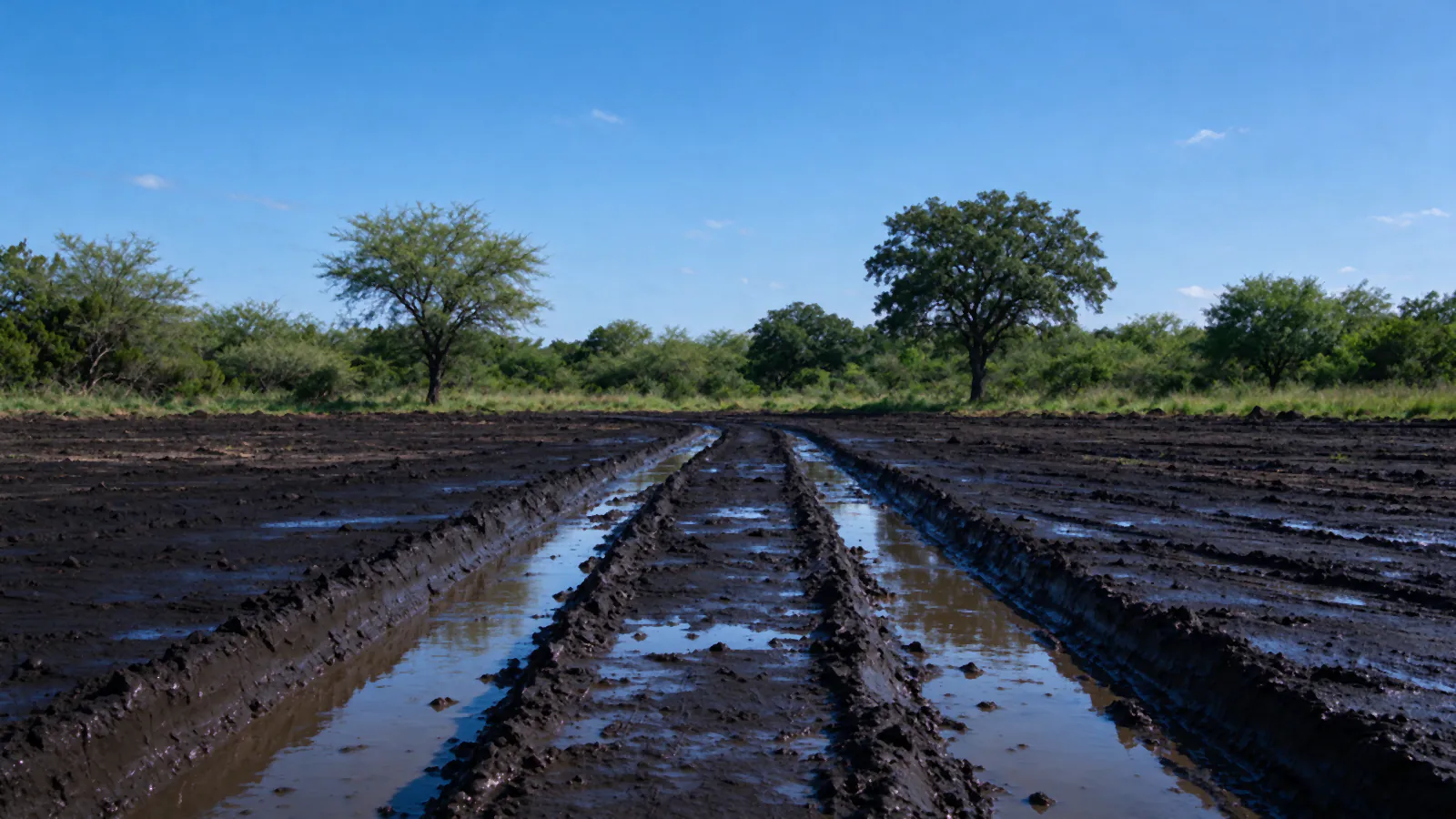
Short answer: on the deep black clays east of I-35, clearing in saturated ground ruts the soil badly, and those ruts dry into hard ridges that cost money to regrade. Waiting a few dry days after a soaking rain, until the surface stops smearing under a boot, is usually cheaper than working through it. Bell County’s wettest stretches are May and September through October.
Arcady Temple Land Clearing schedules clearing around the clay on most jobs east of I-35, and this guide explains why.
What makes Bell County clay different
The most common soil in Bell County by acreage is Houston Black clay, a Blackland Prairie soil that dominates the country around Temple, Troy, Holland and Rogers. Related clays such as Heiden, Branyon and Burleson cover much of the rest of the eastern county. These are vertisols: they swell when wet and shrink and crack when dry.
When they are wet, the surface becomes slick and plastic. Tracks sink, smear the soil and leave ruts that hold water. When the clay dries, those ruts set hard, often with ridges that a mower or a builder’s trucks cannot cross without regrading.
West of I-35, on the stony limestone soils around Belton’s west side and Harker Heights, rain drains faster and rutting is less of a problem, though steep bare slopes wash.
The calendar
NOAA’s 1991 to 2020 climate normals for Bell County stations show two wet peaks:
| Month | Troy | Stillhouse Hollow Dam |
|---|---|---|
| May | 5.55 in | 4.85 in |
| September | 3.70 in | 3.74 in |
| October | 3.44 in | 4.00 in |
| July (driest) | 1.88 in | 1.85 in |
Annual totals run about 37 to 38 inches. Clearing on clay is easiest in the drier stretches, though late summer brings its own problem: county burn bans are most likely then.
Rain in the forecast?
Scheduling around the clay is part of the plan. Send the address and your timeline.
How to tell when the ground is ready
- The boot test. Walk the low spots. If soil sticks to your boots in clumps or smears when you twist your foot, it is too wet.
- Standing water. If water still sits in the low spots or tire tracks, the clay around them is saturated.
- Surface cracks. Fine cracks starting to open mean the surface is drying; wide, deep cracks in mid-summer mean it is very dry and hard.
Low spots, draws and areas under dense cedar or brush stay wet longest, because shade slows drying.
What rutting costs
Ruts on a building pad or driveway corridor mean extra dirt work before the slab: filling, recompacting and regrading. Ruts in a pasture leave ridges that shake equipment and trip livestock, and they can channel runoff into gullies. On a residential lot, the cost of fixing ruts can easily exceed the cost of waiting a few days.
Method and weather
Forestry mulching disturbs the soil least, and the chip layer it leaves protects the surface from the next rain, but the tracks still rut saturated clay. Grubbing leaves bare soil that washes and ruts more easily, so it is timed for dry spells and followed quickly by the dirt contractor or by seed. The mulching versus grubbing guide compares them.
On a construction site, bare clay also sheds sediment in a storm, which is why silt fence goes in before or as the ground opens. See erosion control after clearing.
Clay on the road
Wet clay does not stay on the site. It packs into tracks and tires and comes off in slabs on the county road or the subdivision street, where it is slick for drivers and hard to scrape up once it dries. On a construction site, a rock entrance pad where trucks leave keeps most of it off the pavement. On a rural tract, unloading the machine on a dry spot near the gate and keeping trailers off the wettest ground does much of the same work.
What it means for a schedule
A clearing schedule on clay has slack built in. A job planned for one machine day can take longer if rain falls between the estimate and the start date, and a crew may leave and come back rather than tear up a lot. The guide on how long it takes to clear an acre covers the other things that set a schedule, and how clear a lot must be before you build explains why clearing close to the dirt crew’s start date helps.
For a schedule that works with the weather, call (254) 269-4999 or send the details below.