
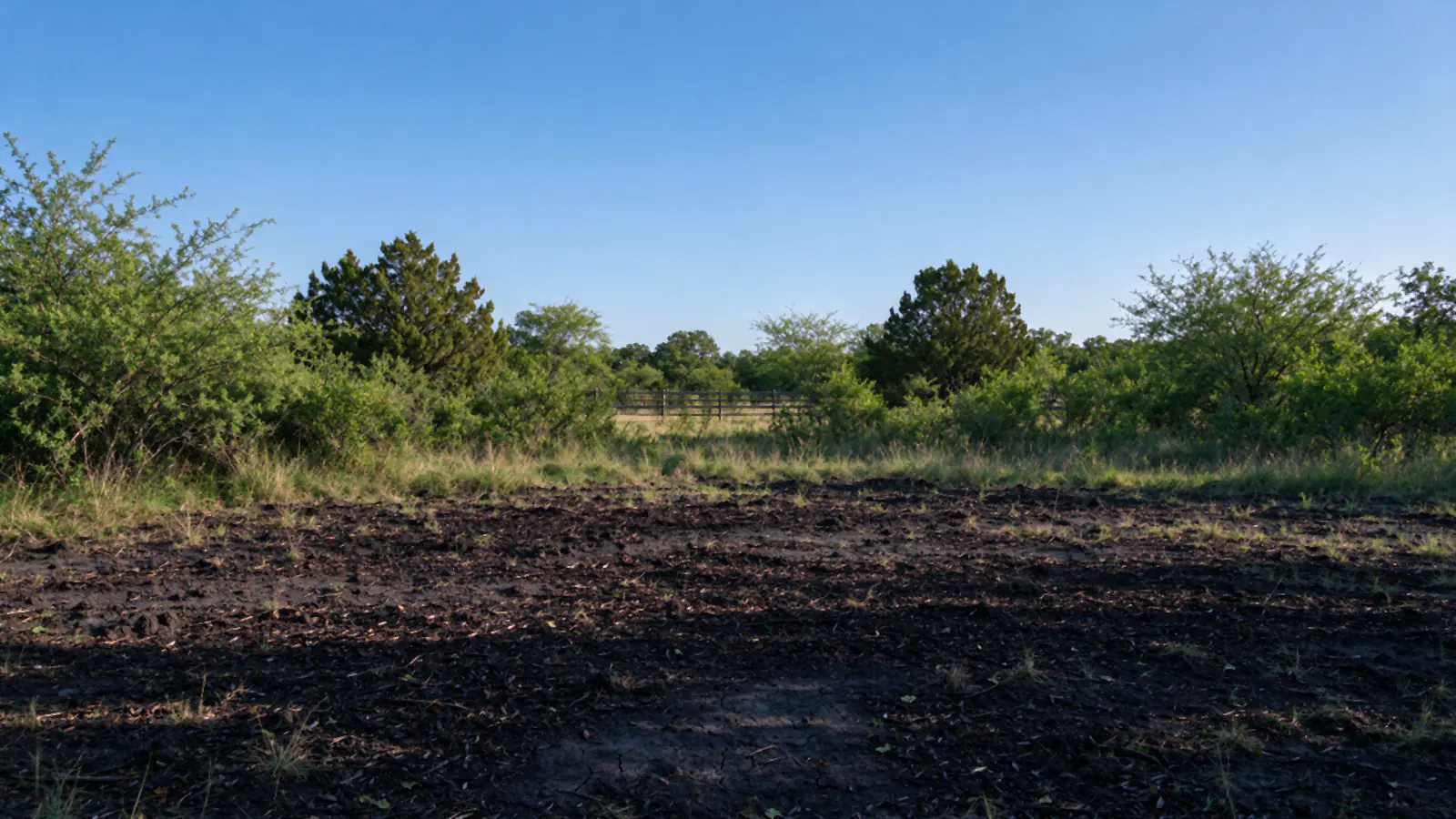
Short answer: typical Central Texas budgeting ranges run about $1,300 to $5,200 or more an acre for forestry mulching, depending on how thick the growth is, and roughly $3,000 to $8,500 or more an acre to clear, grub and haul. Small jobs are priced around a machine day, about $3,000 to $4,000. For acreage with cedar, mulching is usually the cheaper method.
Arcady Temple Land Clearing publishes these ranges so you can judge a quote before anyone walks your land. They are typical budgeting figures for Central Texas projects, not our rates and not a set price for your land. Your estimate depends on the drivers below.
Typical ranges by method
| Method and growth | Typical Central Texas range |
|---|---|
| Forestry mulching, light brush and understory | $1,300 to $2,500 per acre |
| Forestry mulching, mixed cedar, mesquite and small trees | $1,600 to $4,000 per acre |
| Forestry mulching, dense or older cedar, larger stems, rock | $2,700 to $5,200 or more per acre |
| Clear, grub and haul, light | about $3,000 to $4,500 per acre |
| Clear, grub and haul, moderate | about $4,000 to $6,000 per acre |
| Clear, grub and haul, heavy, rock or large stumps | $6,000 to $8,500 or more per acre |
| One compact mulcher day | about $3,000, often with transport |
| One large mulcher day | about $4,000 plus transport |
Per-acre prices fall as acreage grows, because the cost of bringing a machine to the site gets spread across more ground. The method matters as much as the size: forestry mulching leaves debris as cover, while lot clearing for a house pad usually means grubbing and hauling. A 20-acre pasture can come in well under the per-acre figure for a single residential lot with the same growth on it.
What’s inside a Temple land clearing price
A clearing price is mostly machine time. Around it sit transport, debris handling, erosion control and, sometimes, permits. Some of those parts have public figures; others do not.
| Part of the price | What sets it | Local figure, where one exists |
|---|---|---|
| Machine time | Stem density, trunk size, rock, slope, wet ground | Texas A&M AgriLife Extension’s custom rates survey for its East region, which includes Bell County, reported dozer land clearing at $120 to $250 an hour for machines under 160 hp, averaging about $159 |
| Large-scale brush removal | Acreage and access | Recent TxDOT highway contracts in Bell County paid $1,000 to $1,750 an acre for brush removal (low bids) |
| Tree removal by size | Trunk diameter | On a Bell County TxDOT contract, low bids ran $170 each for 4 to 12 inch trees, $175 for 12 to 18 inch and $200 for 18 to 24 inch |
| Debris disposal | Haul distance, load count | Temple Landfill on Loop 363 charges non-residents a minimum of $58.24 plus a $0.94 state fee per load, and loads must be covered |
| Burning instead of hauling | City rules, county bans | Belton’s open burn permit is $100 residential or $300 commercial, with an inspection |
| Erosion control | Bare soil, slope, a construction permit | Bell County TxDOT contracts paid about $3.30 to $5.90 a foot to install silt fence and $1.00 to $1.70 to remove it |
| Stormwater permit | Construction disturbing an acre or more | The state construction general permit applies; large sites file a notice of intent with TCEQ |
| Labor | Crew and operator time | No current Killeen-Temple wage figure was available for this guide |
| Restoration | Seeding, grading, fill | Scope to check on your site; grading and fill belong to the dirt contractor |
Where a burn is possible, the guide to burning brush in Bell County compares it with mulching and hauling. A wage or an hourly machine rate is not a billing rate. A contractor’s price also carries insurance, transport, fuel, wear on the cutting teeth and overhead.
Want a range for your acreage?
The estimator gives a typical range from your acreage, growth and finish. An estimate after a site walk gives the real number.
What pushes a price up or down
| Driver | Pushes toward the low end | Pushes toward the high end |
|---|---|---|
| Growth | Brush and saplings | Dense cedar, trunks over 8 inches |
| Ground | Deep soil, dry | Limestone near the surface, wet clay |
| Finish | Mulched at grade | Stumps and roots out (grubbing) |
| Debris | Left as mulch | Hauled to the landfill |
| Trees kept | None or a few | Many keepers, tight spacing |
| Hidden debris | Clean tract | Old fence wire, concrete, dumped trash |
| Size | Larger acreage | Small lot with a machine-day floor |
The estimate checklist guide shows how to read two quotes side by side, and how long it takes to clear an acre explains how these drivers turn into machine days.
Illustrative budgets
These examples are illustrative, built from the typical ranges above. They are not quotes.
A half-acre lot in Temple, brush and small trees, mulched. One compact mulcher day, about $3,000. If the house pad needs grubbing and the debris has to go to the landfill, expect it to rise toward the clear-and-grub range for that part of the lot.
Five acres of mixed cedar and mesquite west of Belton, mulched. At $1,600 to $4,000 an acre, about $8,000 to $20,000. Rock near the surface pushes it toward the top.
Twenty acres of light pasture brush near Troy, shredded or mulched. Toward the low end of the mulching range, or lower for simple shredding. AgriLife’s East region survey put pasture shredding at about $15 to $75 an acre.
Permits and fees that can apply
| Where | Rule | Fee |
|---|---|---|
| Temple city limits | Outdoor burning banned except land-clearing burns the Fire Marshal permits when no practical alternative exists | Ask Temple Fire & Rescue |
| Temple I-35 corridor overlay | Trees over 8 inches within or near the floodplain protected; replacement or fee | $100 per caliper inch paid to Parks where trees cannot be replaced on site |
| Belton city limits | Open burn permit at all times, with inspection | $100 residential, $300 commercial |
| Unincorporated Bell County | Land-clearing burns allowed under state rules unless a county burn ban is on | None for the burn itself |
| Any construction site disturbing an acre or more | State construction stormwater permit | TCEQ notice of intent for large sites |
Rules change, so the Bell County land clearing rules guide is checked against each address before work starts.
For a number for your own land, call (254) 269-4999 or send the details below.