
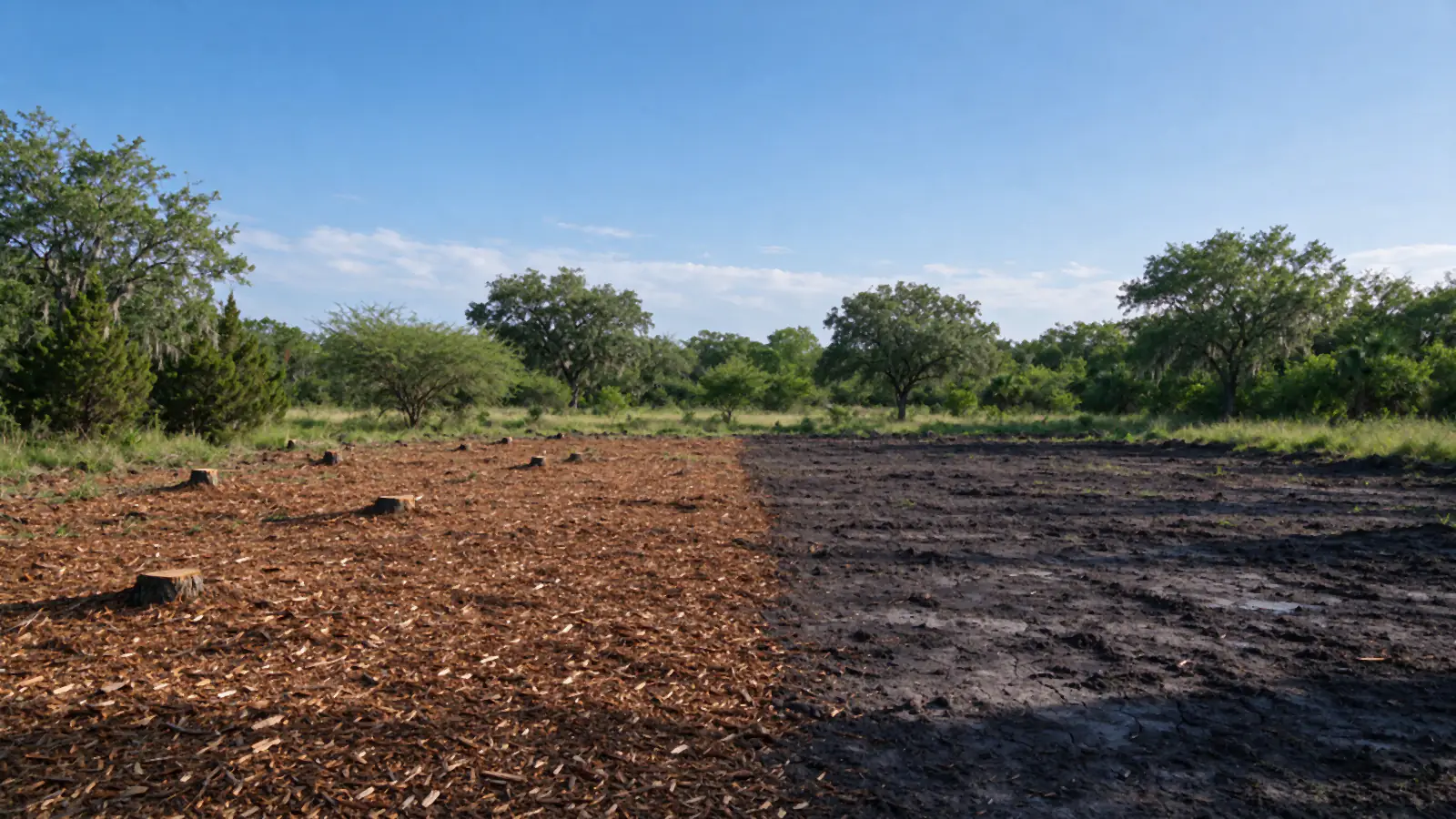
Short answer: mulch where the goal is grass, trails, a view or fire safety; grub where anything structural will sit. Forestry mulching grinds vegetation to about ground level and leaves roots and chips in place. Clearing and grubbing removes trees, stumps, roots and buried organic matter. Many Bell County lots get both.
Arcady Temple Land Clearing arranges both kinds of work across Bell County and splits most lots between them.
What each method actually does
Forestry mulching uses a heavy drum of fixed teeth on a tracked carrier. It grinds brush, cedar and small trees where they stand and spreads the result as chips. Stumps finish at or just below grade. Roots stay in the soil and rot over years. Nothing is piled or hauled.
Clearing and grubbing is two steps. Clearing removes trees and vegetation, usually by cutting and moving them with an excavator, dozer or loader. Grubbing removes what is left below ground: stumps, root balls, roots and organic material. The debris is mulched, hauled or, where the rules allow, burned. The soil is left bare.
| Question | Forestry mulching | Clear and grub |
|---|---|---|
| Stumps | Ground to about grade | Pulled out with roots |
| Roots | Stay in the soil | Removed |
| Debris | Left as mulch | Hauled, mulched or burned |
| Soil | Covered | Bare; erosion control needed |
| Next step | Grass, trails, fence | Dirt work, pad, driveway |
Why roots matter under a structure
Roots left under a slab or driveway rot. As they rot, they leave voids and soft spots, and the ground above settles unevenly over a few years. On the shrink-swell clays common around Temple, that settling adds to movement the soil already causes. That is why builders want the footprint grubbed, and why mulching alone is never a building-pad finish. The guide on how clear a lot needs to be before you build covers what else the pad needs.
Why mulching wins everywhere else
Away from structures, roots in the ground are an advantage. They hold the soil while grass comes back, and the chip layer on top slows erosion, holds moisture through a dry summer and suppresses weeds. Mulching disturbs very little soil, needs no burn permit and produces no haul tickets. For pastures, wooded lots, trails, fence lines and fire breaks, it is usually the right first answer.
Not sure where the line falls on your lot?
Send the site plan or a sketch. The footprint gets grubbed; the rest can usually be mulched.
How Bell County ground changes the choice
On the shallow, stony soils west of I-35, around Belton’s west side, Harker Heights and Nolanville, rock limits both methods. A mulching head cannot grind through limestone, so stumps can finish a few inches high. Grubbing can hit rock before the roots end. On those lots, a pad may need rock work from the dirt contractor anyway.
On the deep clays east of I-35, around Temple, Troy and Holland, rock is rarely the issue. Wet clay is. Grubbing leaves bare clay that ruts and washes in the May and fall rains, so it is timed for dry spells and followed quickly by the dirt contractor or by seed. The guide to clearing after rain on black clay explains how to judge the ground.
Species can decide it too
- Ashe juniper (cedar) does not resprout once cut below its lowest green limb, so mulching removes it for good.
- Mesquite resprouts from buds just below the soil line. Mulching leaves those buds; grubbing below them, about 14 inches, removes them. See mesquite removal.
- Hardwoods such as hackberry and elm resprout from stumps and roots after mulching, which a mowing pass in the first year handles.
A typical split on one homesite
- The house pad, driveway and any shop or slab: cleared and grubbed, stumps and roots out, debris hauled or mulched elsewhere.
- The yard around the house: mulched, stumps ground, keepers protected, as in selective clearing.
- The back acreage: mulched or left.
That split is usually cheaper than grubbing everything and leaves the lot easier to grow grass on.
Cost difference
Typical Central Texas budgeting ranges run about $1,300 to $5,200 or more an acre for mulching, depending on density, and roughly $3,000 to $8,500 or more an acre for clear, grub and haul. The difference comes from the extra machine work, the hauling and the erosion control grubbing needs. The land clearing cost guide breaks that down.
To work out the split for your land, call (254) 269-4999 or send the details below.