
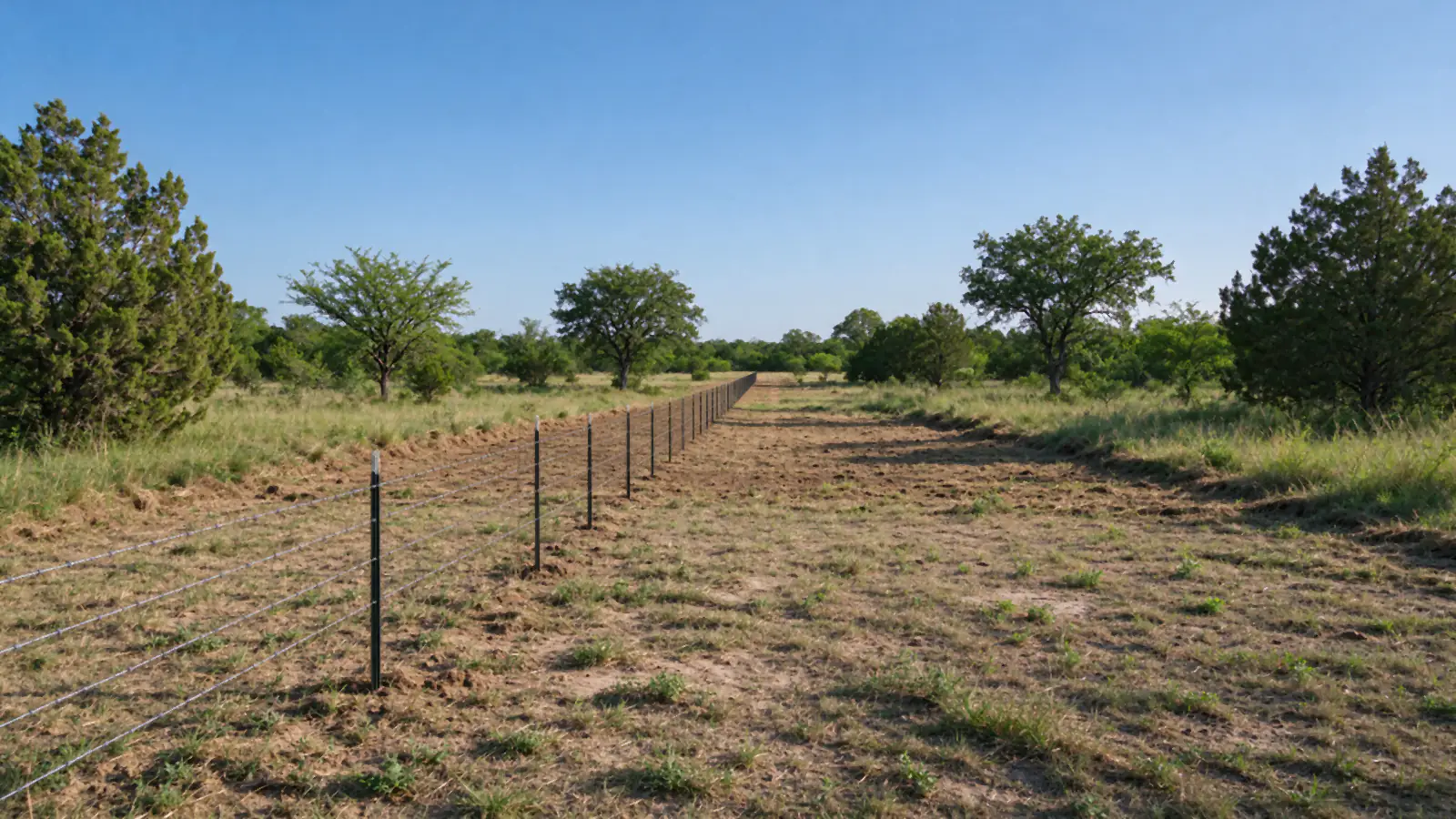
Short answer: clear wide enough for the equipment that will build the fence, usually a pickup or tractor with a post driver or auger and room to stretch wire, plus a strip on each side that a mower can run along every year. The common mistake is clearing too narrow: brush leans back in from the edges and seedlings fill the gap within a season.
Arcady Temple Land Clearing clears fence lines, trails and corridors across Bell County, and width is the first question on each one.
What sets the width
Four things decide the width, and each one adds to the last.
- The fence crew’s machine. A truck or tractor carrying posts and wire, with a post driver or auger, has to drive along the line. Its width, plus room to work beside it, is the starting point.
- Room to stretch wire. Barbed and net wire are stretched in long straight runs, so the strip has to be straight and free of stumps that would snag the wire.
- A mowing strip. After the fence is built, a mower has to reach the base of the fence every year, or the strip closes in.
- The lean of the brush. Cedar and hackberry along an old fence lean in toward the light. Cutting back to where the canopy starts, not just to the trunks, keeps branches off the new wire.
By job
| Job | What drives the width |
|---|---|
| New fence on open ground | Crew vehicle, wire stretching, mowing strip |
| Replacing a worn-out fence | Space to roll up the old wire and drive new posts where the old ones stood |
| Keeping an existing fence open | A mower’s width on each side |
| Pipe fence | A lane wide enough for the welding rig to follow the line |
| Wood or board fence by a home | A tighter strip, with hand work close to buildings |
Fence line clearing covers how each of these is done.
Know the fence length and type?
Send them with a few photos. The fence type sets the width, and the width sets the price.
Why fence lines fill in fast
Fence lines are where birds perch, and birds drop the seed of cedar, hackberry and other berry-bearing plants. Mowers cannot reach the base of the fence, so seedlings get a head start. A cleared fence line left alone for a few years can look like it was never cleared. Cedar cut below its lowest green limb will not resprout, but new seedlings will arrive; mesquite and hackberry resprout from their stumps. The guide on whether brush grows back after clearing explains which species return.
Slope, draws and creeks
On a slope, a cleared strip running straight downhill can channel water and start a gully. Leaving grass cover, cutting rather than grubbing, and leaving water gaps where the line crosses a draw keep the strip from washing. Where a fence crosses a creek, plan how water and debris will pass before the strip is cut.
Old wire in the strip
An old fence line rarely leaves cleanly. Sections of barbed wire lie buried in leaf litter, loose stays and T-posts lean into the brush, and earlier fences may sit a few feet off the current one. Wire caught in a mulching head stops the machine and has to be cut free by hand, so on rebuilds the old wire is usually rolled up and posts pulled before the strip is mulched.
Neighbors and boundaries
Clearing your own side needs no agreement. Clearing the neighbor’s side, or building a shared fence, does. Old ranch fences in Bell County often wander off the deed line by a few feet or more, so a surveyor’s corner markers are worth locating before a new fence goes in on an old route.
What the width does to the price
A fence strip is quoted on its footage and how wide it runs; how thick the brush is and how much buried wire turns up move it from there. Doubling the width roughly doubles the area cleared. The estimate checklist shows how a fence line quote should state width and length, and how long it takes to clear an acre explains how strip length turns into machine time. On ag land, see clearing ag land and property taxes; for typical ranges, the cost guide.
To work out the right width for your fence, call (254) 269-4999 or send the length and fence type below.