
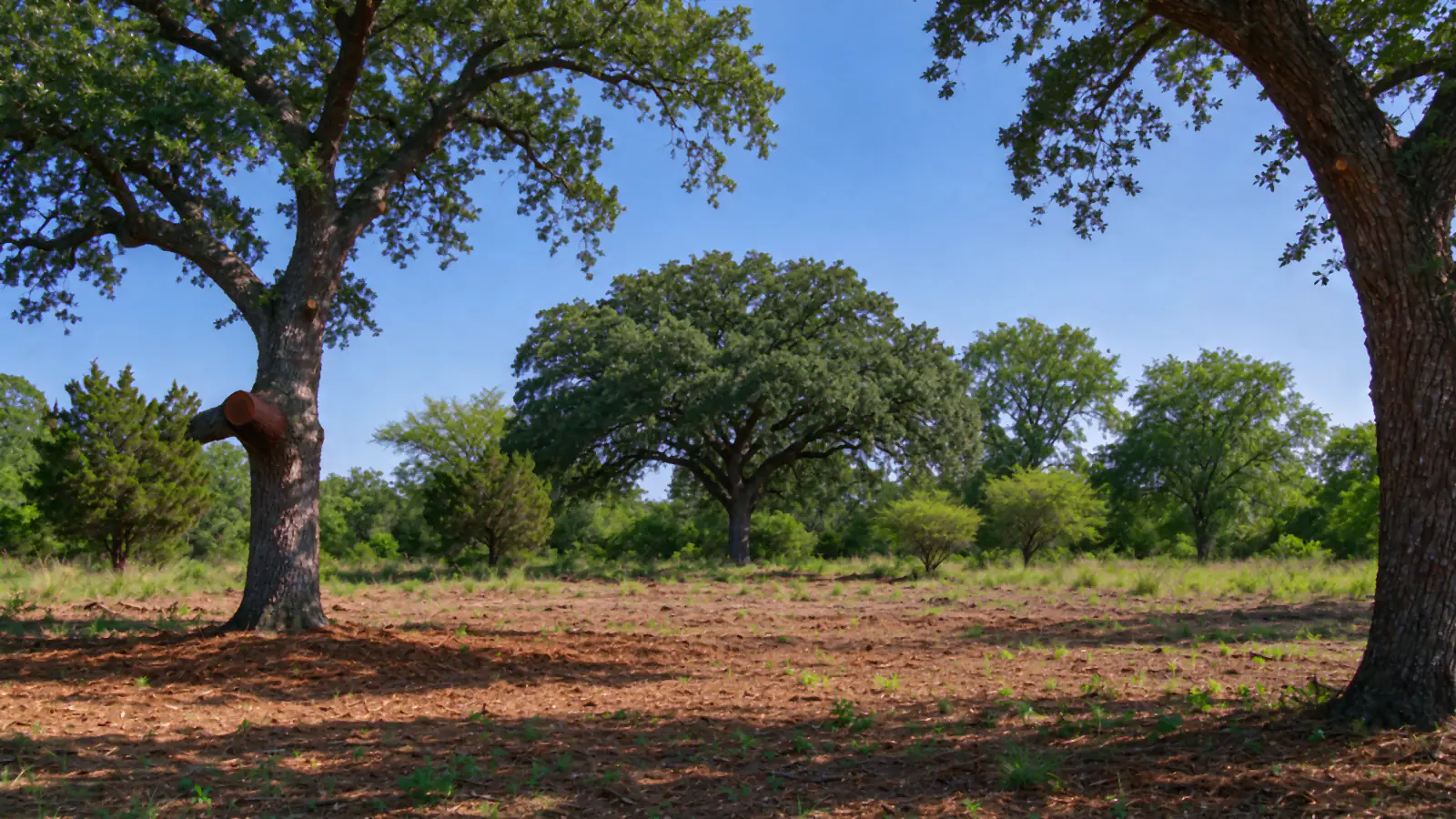
Short answer: avoid wounding oaks from February through June, paint any fresh oak wound at any time of year, keep machines out of the root zones of oaks you are keeping, and take the most care around red oaks and live oaks. Texas A&M Forest Service lists land and cedar clearing among the activities that create the wounds oak wilt uses.
Arcady Temple Land Clearing plans clearing around oaks with this calendar on every tract where oaks are being kept.
What oak wilt is
Oak wilt is a fungal disease that blocks the water-carrying tissue of oak trees. Texas A&M Forest Service and the USDA Forest Service report it in 76 documented Texas counties, mostly west of I-35 from Dallas to San Antonio, with a cooperative suppression program active in Central Texas. Once a tree is infected, it often dies, and the disease can spread to its neighbors.
How it spreads
Oak wilt moves in two ways.
- Overland, by beetles. Small sap beetles carry spores from fungal mats on infected red oaks to fresh wounds on healthy oaks. The beetles are most active in late winter and spring, which is why the February through June window matters.
- Underground, through roots. Live oaks grow in groups with connected root systems, so an infected live oak can pass the disease to its neighbors through those roots.
That is why red oaks and live oaks get the most attention around clearing: red oaks produce the spore mats, and live oaks spread the disease underground.
How clearing creates risk
Texas A&M Forest Service lists land and cedar clearing among the activities that wound trees, alongside pruning, construction, livestock, mowers, string trimmers and storms. On a clearing job, the usual wounds are:
- bark scraped by a mulching head or a falling cedar;
- surface roots torn by tracks or a dozer blade;
- branches broken where machines pass under a canopy.
Clearing around oaks this spring?
Tell us how many oaks you are keeping and when you hoped to start.
How clearing around oaks is planned
- Flag the keepers. Every oak to keep is marked on the walk-through, with a working line outside its drip line.
- Plan machine routes. Machines reach the cedar and brush without crossing root zones.
- Hand cut near trunks. The last few feet around an oak are cut by hand.
- Time it. Where possible, work near oaks is done outside February through June. Inside that window it is done with extra care.
- Paint wounds. Any fresh wound on an oak is painted right away, whatever the month.
Selective clearing is built around these steps, and they apply to cedar clearing in mixed stands too.
Signs worth reporting
Owners often notice oak wilt before anyone else. On live oaks, the classic sign is leaves with yellow or brown veins, followed by leaf drop and a crown that thins over weeks or months, often spreading tree to tree through a group. Red oaks tend to wilt quickly in spring and early summer, browning all at once. If oaks on a tract show these signs before clearing starts, Texas A&M Forest Service foresters can confirm it, and the clearing plan can keep machines and cut wood away from the affected group.
Firewood and cut oaks
Freshly cut wood from oaks that died of oak wilt can carry the fungus. When oaks are removed during clearing, it is worth knowing whether any were dying before work started, and not moving wood from those trees to other properties. Texas A&M Forest Service can help identify oak wilt on a property.
Cedar, oaks and the warbler
Cedar mixed with oaks on steep, shaded slopes is also the kind of woodland the golden-cheeked warbler uses. On a tract like that, the oak wilt calendar and the warbler survey window, March 15 to June 1, overlap, so planning is done early. See the golden-cheeked warbler guide.
Follow-up work around oaks
Mowing and trimming after clearing can wound oaks too. The same calendar applies to follow-up passes, as the guides on what to do after forestry mulching and whether brush grows back note. The Bell County rules guide lists oak wilt alongside the other seasonal rules, and the estimate checklist shows how a quote should name the trees kept.
For clearing around oaks, call (254) 269-4999 or send photos below.