
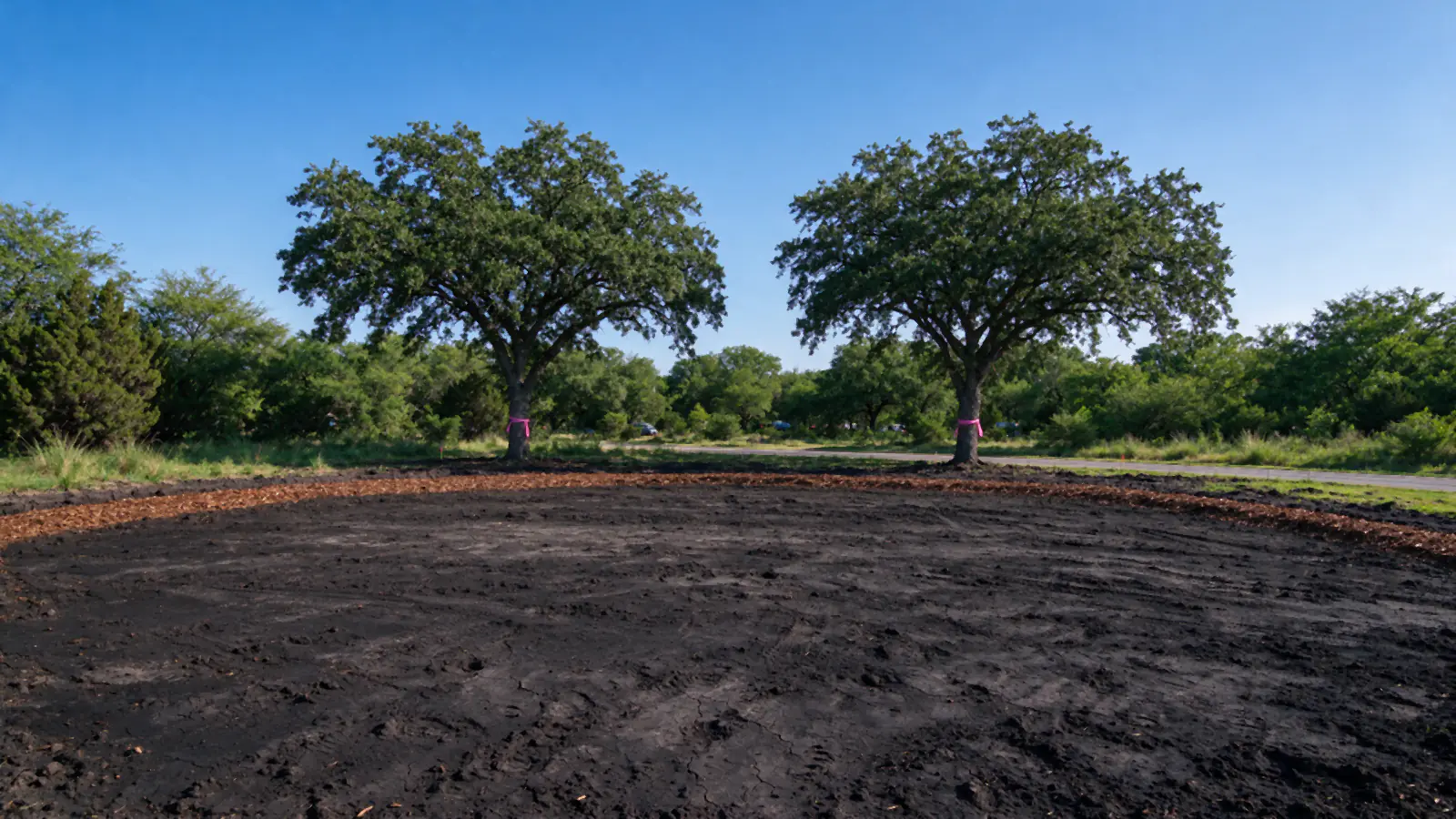
This is an illustrative example. The lot, the owner and the details below are a composite, made up to show how a homesite clearing typically runs in Bell County. It is not a record of a real job or customer.
Arcady Temple Land Clearing uses this sequence on homesites around Temple, and each step below matches a decision the owner, the builder or the clearing crew has to make.
The lot
Picture a half-acre lot east of Temple, on the deep black clay. It has been vacant for years. Cedar and hackberry have filled in along the back fence, there are a few mesquite clumps in the middle, and two good live oaks near the street. The owner has a builder and a site plan with the house pad and driveway drawn on it.
Step 1: Photos and the site plan
The owner sends photos of the thickest growth, the oaks and the back fence, plus the site plan. That is enough to see the job’s shape: a pad and a drive that need grubbing, brush elsewhere that can be mulched, and two trees worth keeping.
Step 2: The walk-through
On site, the walk-through answers what photos cannot. Where exactly is the pad staked? How much working room does the builder want around it? Is there old wire in the back fence row? Do the oaks have roots near where trucks will turn? Is the ground dry enough, or did it rain last week?
On this lot, the walk finds old barbed wire in the fence row and a low spot that holds water after rain. Both go into the estimate.
Step 3: The estimate
The written estimate names each area and what happens there: grub the pad and drive with stumps and root balls out, mulch the brush on the rest, flag and protect the two oaks, pull the old wire by hand, and leave grading and fill to the dirt contractor. It lists who requests the Texas811 locate, since grubbing reaches 16 inches. The estimate checklist shows the full set of lines.
Have a site plan for your lot?
Send it with a few photos. The pad and the keepers decide most of the plan.
Step 4: Before the machine arrives
The locate request goes in, and the utility marks appear. The two oaks get flagged with a working line outside their drip line. Because it is spring, inside the oak wilt window, any accidental wound on an oak will be painted right away. The oak wilt guide explains why.
Step 5: Clearing day
The old wire comes out first, by hand. The mulcher works the back fence row and the scattered brush outside the pad, leaving a chip layer. Then the pad and drive are grubbed: stumps and root balls pulled, the mesquite taken below its bud zone so it does not come back, and holes filled. The stump grinding versus removal guide explains why grinding is not enough under a slab. The root balls and trunks too big to mulch are loaded for the landfill.
The low spot stays soft, so the machine stays off it and that corner is finished by hand. Without rain, the whole lot takes part of one machine day.
Step 6: The handoff
The finished lot has a grubbed pad and drive, mulched ground around them, two protected oaks and no debris piles. The builder’s dirt contractor can bring in fill and start compaction. The guide on how clear a lot needs to be before you build covers that line between clearing and dirt work.
What changes on a real lot
Real lots differ in the details that set time and price: more keepers, rock west of I-35, a wet spring that pushes the start back, a city burn or tree rule, or a builder who wants topsoil stripped. The guide on how long it takes to clear an acre covers the factors.
For your lot, call (254) 269-4999 or send the site plan below.